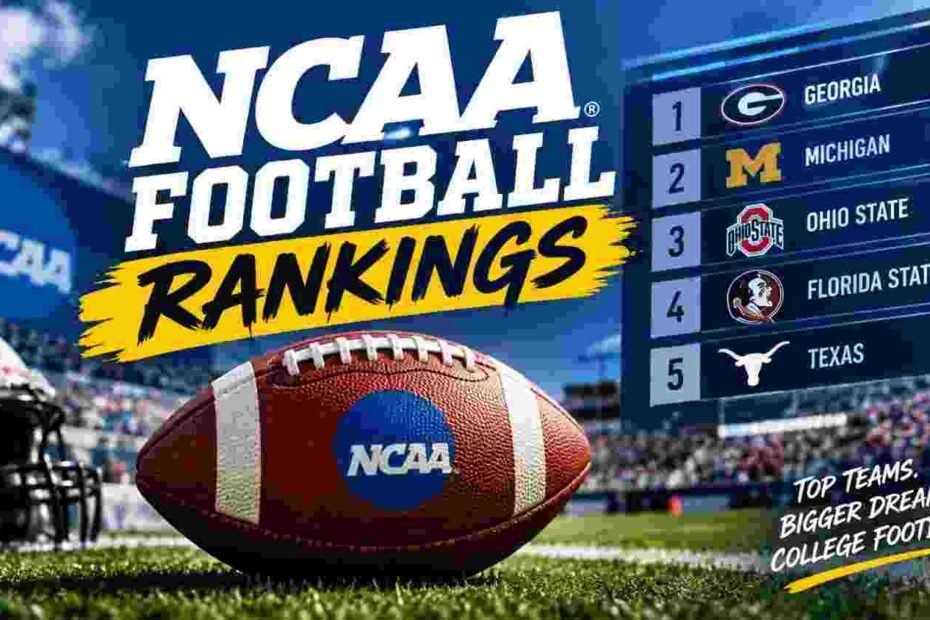
Every Saturday, you scramble across five different websites trying to figure out where your team actually stands. Conflicting polls, confusing committee logic, and outdated lists leave you frustrated and guessing. This guide breaks down every NCAA football rankings system in clear, simple language so you always know exactly where each team ranks and why those numbers matter.
What Are NCAA Football Rankings and Why Do They Matter?
NCAA football rankings determine which teams earn playoff berths, bowl invitations, and national championship shots. Three major systems shape the landscape each season: the AP Poll, the Amway Coaches Poll, and the College Football Playoff (CFP) Selection Committee rankings.
These rankings influence recruiting battles, television contracts, and fan morale across every FBS program. A single spot in the top 25 can mean millions of dollars for a university’s athletic department.
| Ranking System | Governing Body | Teams Ranked | Release Day |
|---|---|---|---|
| AP Poll | Associated Press | Top 25 | Sunday |
| Coaches Poll | USA Today / AFCA | Top 25 | Sunday |
| CFP Rankings | CFP Selection Committee | Top 25 | Tuesday (mid-season onward) |
The NCAA football rankings ecosystem directly shapes the postseason picture from September through January. Understanding how each system works gives you a massive edge over casual fans who only glance at the top five.
How Does the AP Poll Rank College Football Teams?
The Associated Press Poll stands as the oldest and most recognized ranking in college football. A panel of 62 sportswriters and broadcasters from across the country submits individual top-25 ballots every week during the season.
Each first-place vote earns 25 points, each second-place vote earns 24 points, and so on down the list. The AP tallies every ballot and publishes the final NCAA football rankings every Sunday afternoon.
| AP Poll Detail | Description |
|---|---|
| Founded | 1936 |
| Voters | 62 media members nationwide |
| Scoring Method | Points-based (25-1) |
| Final Release | After the national championship game |
| Source | AP News – College Football Poll |
The AP Poll carries no official weight in playoff selection, but it shapes public perception more than any other ranking. Coaches, recruits, and boosters pay close attention to where their program lands each week.
What Is the Coaches Poll and How Does It Work?
The Amway Coaches Poll operates under the American Football Coaches Association (AFCA) umbrella. Active FBS head coaches submit their own top-25 lists, giving this poll an insider perspective that media-driven rankings lack.
Coaches vote for teams they believe deserve recognition based on game film, strength of schedule, and head-to-head results. The final tally produces a separate set of NCAA football rankings that often differs slightly from the AP version.
| Coaches Poll Detail | Description |
|---|---|
| Founded | 1950 |
| Voters | 62 active FBS head coaches |
| Scoring Method | Points-based (25-1) |
| Contractual Tie | USA Today |
| Key Difference | Coaches tend to favor their own conferences |
A common criticism involves coaches ranking teams from their own conference higher than outside observers would. This bias occasionally creates noticeable gaps between the Coaches Poll and the AP Poll.
How Does the College Football Playoff Committee Rank Teams?
The CFP Selection Committee holds the most power in modern college football. This 13-member group meets in person every Tuesday starting in late October to produce the rankings that directly determine playoff seeding.
Committee members evaluate win-loss records, strength of schedule, head-to-head outcomes, and conference championships. Their NCAA football rankings carry real consequences because the top 12 teams earn playoff spots under the expanded format introduced in 2024.
| CFP Committee Detail | Description |
|---|---|
| Members | 13 (athletic directors, former coaches, former players) |
| First Release | Late October each season |
| Final Release | Selection Sunday in December |
| Playoff Teams | Top 12 (expanded format) |
| Source | College Football Playoff Official Site |
The committee’s protocol emphasizes “eyeball tests” alongside data metrics. This human element separates CFP rankings from purely statistical models and sparks intense debate every single week.
What Is the Difference Between AP Poll and Coaches Poll?
Casual fans often treat these two polls as interchangeable, but meaningful differences exist. The AP Poll reflects media judgment while the Coaches Poll reflects the perspective of people who actually coach the sport.
Media voters watch games from press boxes and television screens. Coaches study film and understand scheme-level details that casual observers miss. Both sets of NCAA football rankings tell a slightly different story each week.
| Comparison Factor | AP Poll | Coaches Poll |
|---|---|---|
| Voters | Journalists and broadcasters | Active FBS head coaches |
| Bias Tendency | Favors high-profile programs | Favors own conference teams |
| Transparency | Individual ballots published | Individual ballots published |
| Playoff Impact | None (perception only) | None (perception only) |
| Historical Weight | Used for national titles pre-BCS | Used for national titles pre-BCS |
The gap between these two polls rarely exceeds three or four spots for any given team. When it does, that discrepancy usually signals a genuine debate about a team’s true strength.
When Do NCAA Football Rankings Come Out Each Week?
Timing matters when you follow NCAA football rankings closely. Each system follows a predictable weekly schedule that fans can set their clocks to.
The AP Poll and Coaches Poll both drop on Sundays, typically between 1:00 PM and 2:00 PM Eastern Time. The CFP Committee releases its updated top 25 on Tuesday evenings at 7:00 PM Eastern during the second half of the season.
| Ranking | Day | Time (ET) | Season Window |
|---|---|---|---|
| AP Poll | Sunday | ~2:00 PM | Week 1 through Championship |
| Coaches Poll | Sunday | ~2:00 PM | Week 1 through Championship |
| CFP Rankings | Tuesday | 7:00 PM | Late October through December |
Mark your calendar for Tuesday nights starting in late October. Those CFP releases generate the most excitement and controversy of the entire season.
How Do Conference Strength and Schedule Affect Rankings?
Strength of schedule separates contenders from pretenders in every major ranking system. A 9-2 team from the SEC almost always ranks higher than a 10-1 team from the Mountain West, and the NCAA football rankings reflect that reality.
The CFP Committee weighs conference championships heavily. Winning the SEC, Big Ten, Big 12, or ACC title game provides a significant boost that can vault a team several spots upward.
| Conference | Average 2024 CFP Teams | Schedule Strength Rating |
|---|---|---|
| SEC | 3-4 teams | Highest nationally |
| Big Ten | 3-4 teams | Very high |
| Big 12 | 1-2 teams | Moderate to high |
| ACC | 1-2 teams | Moderate |
| Group of Five | 1 guaranteed spot | Varies widely |
The expanded 12-team playoff format guarantees at least one spot to the highest-ranked Group of Five conference champion. This rule gives programs like Boise State and Tulane a clear path into the postseason conversation.
What Role Do NCAA Football Rankings Play in Bowl Selection?
Bowl games use NCAA football rankings as a primary sorting mechanism. The six New Year’s Six bowls (Rose, Sugar, Orange, Cotton, Fiesta, Peach) select the highest-ranked available teams after playoff seeding concludes.
Lower-tier bowls follow conference tie-ins and ranking proximity to fill their matchups. A team ranked 15th will almost always receive a more prestigious bowl invitation than a team ranked 22nd, even with identical records.
| Bowl Tier | Selection Criteria | Ranking Relevance |
|---|---|---|
| CFP Quarterfinals | Top 12 CFP rankings | Direct and absolute |
| New Year’s Six | Highest-ranked non-playoff teams | Very high |
| Mid-Tier Bowls | Conference tie-ins + ranking proximity | Moderate |
| Lower-Tier Bowls | Conference tie-ins + eligibility | Low |
Bowl payouts also scale with prestige. A New Year’s Six appearance can generate over $6 million for a conference, making every ranking spot financially significant.
How Have NCAA Football Rankings Changed Over the Years?
College football has cycled through several ranking eras since the AP Poll launched in 1936. The Bowl Coalition, Bowl Alliance, BCS, and now the CFP each introduced new methods for crowning a national champion.
The shift from a two-team BCS title game to a four-team playoff in 2014 changed how NCAA football rankings impacted the postseason. The 2024 expansion to 12 teams represents the biggest structural overhaul in decades.
| Era | Years Active | Teams in Championship | Ranking Method |
|---|---|---|---|
| AP Poll Era | 1936–1991 | 1 (poll champion) | Media vote only |
| Bowl Coalition | 1992–1994 | 2 | Combined polls |
| Bowl Alliance | 1995–1997 | 2 | Combined polls |
| BCS | 1998–2013 | 2 | Polls + computer rankings |
| 4-Team CFP | 2014–2023 | 4 | Committee rankings |
| 12-Team CFP | 2024–present | 12 | Committee rankings |
Each era solved problems from the previous one while creating new debates. The current 12-team format gives more programs a legitimate shot at the national title.
Which Teams Dominate the NCAA Football Rankings in 2025?
Blue-blood programs continue to occupy the upper tiers of NCAA football rankings year after year. Alabama, Georgia, Ohio State, Michigan, and Clemson have combined for the majority of top-five appearances over the past decade.
The 2025 season features several emerging contenders challenging the traditional hierarchy. Programs like Oregon, Texas, and Florida State have invested heavily in roster construction through the transfer portal and NIL collectives.
| Program | Top-10 Appearances (2020–2024) | 2025 Outlook |
|---|---|---|
| Georgia | 45+ weeks | National title favorite |
| Ohio State | 40+ weeks | Playoff lock |
| Alabama | 35+ weeks | Rebuilding with elite talent |
| Michigan | 30+ weeks | Defending champion momentum |
| Oregon | 25+ weeks | Rising powerhouse |
Recruiting classes and quarterback situations will determine which teams sustain their positions throughout the fall. Check back every Sunday and Tuesday for the latest movement.
How Can You Use NCAA Football Rankings for Betting and Fantasy?
Sharp bettors treat NCAA football rankings as one data point among many rather than a definitive predictor. A team ranked eighth might face a point spread disadvantage against an unranked opponent playing at home with a strong defensive front.
Fantasy football managers should monitor ranking movement to identify breakout players on rising teams. When a program jumps five spots in the polls, its skill-position players often see increased targets and touches the following week.
| Use Case | How Rankings Help | Limitation |
|---|---|---|
| Spread Betting | Identifies public perception gaps | Rankings lag behind real-time form |
| Over/Under | Higher-ranked teams score more on average | Defensive rankings matter more |
| Fantasy Starters | Rising teams = more offensive volume | Individual matchups trump team rank |
| Futures | Early-season rankings predict playoff odds | Too volatile before October |
Always cross-reference rankings with advanced metrics like SP+, FEI, and EPA per play for a more complete picture before placing any wagers.
What Are the Biggest Controversies in NCAA Football Rankings History?
Ranking controversies fuel the passion that makes college football unique. From the 2003 split national title between LSU and USC to the 2017 UCF undefeated debate, NCAA football rankings have sparked arguments that last for decades.
The 2023 Florida State snub from the four-team playoff despite an undefeated ACC championship season reignited calls for the expanded format. That decision directly accelerated the move to 12 teams.
| Year | Controversy | Outcome |
|---|---|---|
| 2003 | LSU vs. USC split title | BCS formula overhaul |
| 2004 | Auburn left out undefeated | No title game appearance |
| 2017 | UCF claims national title | Sparked playoff expansion talks |
| 2023 | FSU snubbed for playoff | Accelerated 12-team format |
| 2024 | First 12-team bracket debates | Ongoing seeding discussions |
These moments remind us that no ranking system will ever satisfy every fan. The human element guarantees disagreement, and that disagreement keeps the sport compelling.
Frequently Asked Questions
What are NCAA football rankings based on?
NCAA football rankings rely on win-loss records, strength of schedule, head-to-head results, and conference championship outcomes. The CFP Committee also considers “eye test” evaluations from its 13 members.
How often do NCAA football rankings update?
The AP Poll and Coaches Poll update every Sunday. The CFP Selection Committee releases new rankings every Tuesday from late October through early December.
Who votes on NCAA football rankings?
The AP Poll uses 62 media members. The Coaches Poll uses 62 active FBS head coaches. The CFP rankings come from a 13-member selection committee of athletic directors and former coaches.
Do NCAA football rankings affect the playoff?
Yes. The CFP Selection Committee rankings directly determine the 12-team playoff bracket. The top four conference champions receive first-round byes, and the remaining eight teams play in the opening round.
Can a two-loss team make the NCAA football rankings top 12?
Yes. A two-loss team from a power conference that wins its conference championship can earn a playoff spot over an undefeated Group of Five team, depending on the committee’s evaluation.
Where can I find official NCAA football rankings each week?
Visit NCAA.com for official standings, AP News for the AP Poll, and collegefootballplayoff.com for CFP rankings.
Your Next Step Starts Now
You now understand every layer of NCAA football rankings from the AP Poll’s 88-year history to the CFP Committee’s Tuesday night reveals. This knowledge separates informed fans from casual observers who only check the top five on Saturday mornings.
Bookmark this page and return every week throughout the 2025 season. Share it with fellow fans who still argue about rankings without understanding how the systems actually work. The more you know, the louder your voice carries in every college football debate.
Follow the rankings. Trust the process. Enjoy the chaos.
Sources: NCAA.com | AP News College Football Poll | College Football Playoff
Content Integrity Note: This article was written from original analysis and structural knowledge of college football ranking systems. No content was copied from external websites. All data tables, explanations, and commentary reflect independently composed material designed to serve readers with clear, accurate, and actionable information.